

Maddening
Remembering the Life, Legacy, Wit, and Humor of John Madden

Boom! Pow! Whap!
The first time I heard John Madden as a football commentator was also the first time anyone else did.
It was September 23, 1979. I know the date because I looked it up. I remember the day because I thought I had just heard a buffoon like a buffalo bellow.
I was five days shy of eighteen and steeped in Oakland Raiders hatred, thanks to my Dallas Cowboys roots.
The Cowboys were the good guys, and besides the Pittsburgh Steelers, the Cowboys’ primary combatant for 1970s NFL supremacy, the Raiders, were the easiest team to hate. They wore what looked like a Satanic symbol on their helmets, their primary color was black, and so were their souls.
The JourneyMan’s Journal is a reader-supported endeavor.
You may elect to support the work on an annual or monthly basis,
or you may join for free.
Whatever you do, subscribe. It’s why I am here.
Just Win, Baby!
The Raiders’ quarterback was nicknamed “The Snake.”
Kenny “The Snake” Stabler.
He looked like a Country singer who downed a fifth of whiskey between snaps. He was this devil-may-care free spirit who just happened to keep his Raiders in Super Bowl contention. He got his nickname innocently enough from his high school coach who started calling him that after he scrambled for a long, slithering touchdown.
Stabler’s primary targets were a fine lot, too. Fred Biletnikoff, a skinny white guy who looked like the inspiration for the bum in the song King of the Road. Freddy seemed as likely to bum a cigarette off you as to burn you for a long touchdown, and he was known for wearing tons of Stickum® on his hands. He didn’t have to catch the ball; he just had to touch it anywhere and it stuck to him like fly paper.
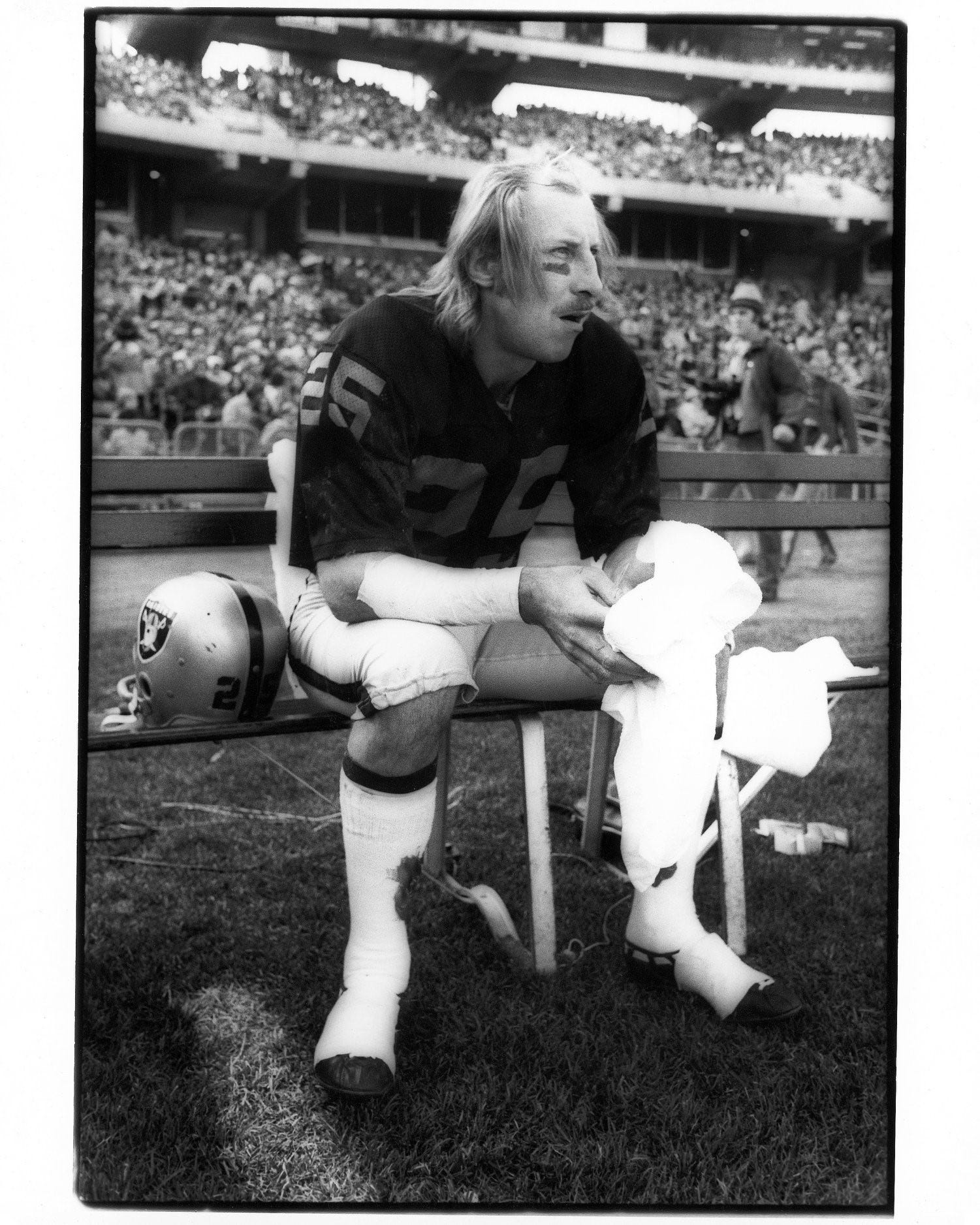
Dave “The Ghost” Casper was one of the first great tight ends to become a household name. Casper was the primary actor in two plays that became legendary enough to get nicknames:
"Ghost to the Post" (1977 Playoffs) – An over-the-shoulder catch from Ken Stabler that set up a game-tying field goal, leading to a Raiders overtime win.
"The Holy Roller" (1978) – A bizarre, controversial play where Casper recovered a fumbled ball in the end zone for a game-winning touchdown against the Chargers.
Everything the Raiders did was controversial.
Safety Jack Tatum was known as a headhunter. His devastating tackles put doubt and the fear of God into the souls of receivers daring to test the middle of the Raiders’ defense. On August 12, 1978, Tatum delivered a (then) legal hit to New England Patriots’ wide receiver, Darryl Stingley. Stingley was immediately paralyzed by the blow.
The Raiders were labeled the NFL’s bad boys. They embraced it.
The Oakland Raiders owner, Al Davis, looked like a used-car salesman or a seedy pimp. He was ornery, a thorn in the league’s side for years, and one of the first owners Jerry Jones consulted when he bought the Cowboys, which explains a lot, come to think of it.
“Just win, baby!”
This was Al Davis’s mantra and is much celebrated and imitated today. Davis often took in players that other teams stayed away from due to temperament or off-the-field issues.
I figured you had to be a gang member or a Satan worshiper to be a Raiders fan. Everybody knows God Himself was a Cowboys fan, and God’s Coach was Tom Landry.
Not ready to commit to monthly support?
You can always do something as simple as
buy your writer a cup of coffee!
Thank you for your support.
Maddening!
John Madden was the Oakland Raiders coach.
Madden was the cartoonish, oversized, ill-kempt, animated sheriff patrolling the sidelines and getting the most out of his band of misfits, miscreants, and malefactors.
He was also destined to become one of the NFL’s greatest legends, and arguably, the greatest of the greats, given his accomplishments as a coach, a broadcaster, and a video game brand.
Madden changed the game—how it is played and perceived—as much as any person in history. He was a driving force in lifting the popularity of the NFL to unequaled success as a television sport. Through Madden, the video game, he has been introducing football to new generations of fans for over a quarter century, and still does, even posthumously.
Madden only coached 10 years, but he guided his team to achieve great heights together, culminating in a Super Bowl XI win over the Minnesota Vikings, another dominant 1970s franchise, at the Rose Bowl in Pasadena, California, on January 9, 1977. His Raiders set a then-Super Bowl record, amassing 429 total yards of offense. Fred Biletnikoff was named MVP for his clutch receptions. Willie Brown scored on a pick-six. The Raiders dominated the famous Purple People-Eaters, the Vikings’ defense.
Madden reached the pinnacle and retired soon after. He burned too hot, too fast, this passionate, lumpy vessel of volcanic fuel. He would soon find himself in a CBS booth alongside the inimitable and consummate professional (though an alcoholic), Pat Summerall. They were singular, Summerall and Madden. They would become legendary.
Later, Madden paired with another emerging icon, Al Michaels, at ABC to fuel a comeback for Monday Night Football, which was once the signature broadcast of an NFL week. He and Michaels then launched what became the next signature game, Sunday Night Football.
If football needed a superhero to lift a fledgling entity like Fox Sports to prominence, to resurrect a once-proud weekly staple like Monday Night Football, or to launch a video game that would capture a new breed of fan, Madden was their guy. He delivered in every instance.
When ESPN talks about “A Football Life,” it is hard to imagine a life more football than that of the late, great John Madden.
Maddenisms
Madden was not into bragging. He believed in humility. It was written all over him. He oozed humanity and humility. He said…
"Self-praise is for losers. Be a winner. Stand for something. Always have class, and be humble.”
Madden was beside himself with the joy of being elected to the Pro Football Hall of Fame.
"I believe that the busts talk to each other... we'll be there forever and ever and ever.”
May we each reach the last bend of the road feeling as lucky as that. Or as blessed.
John Madden summed up his life and work like this:
I’m the luckiest guy in the world. I never really had a job. I was a football player, then a football coach, then a football broadcaster. It’s been my life. Pro football has been my life since 1967. I’ve enjoyed every part of it. Never once did it ever feel like work.
I saw John Madden at the Pearly Gates. St. Peter had come to greet him and maybe get an autograph.
Madden clapped ol’ Pete on the back and said, “Boom! I’m here forever and ever and ever!”
May we each reach the end, like John Madden, Turducken in hand, celebrating a life well lived and a job well done.
Amen.
Do you enjoy my writing?
Did you enjoy this piece?
Why not share it to your network?
And thank you for your supports!